Welcome to HRA Latest with news and updates for those working or involved in health and social care research.
This month, we're sharing our response to new figures that show the set-up times for commercial clinical trials in the UK have continued to drop, with trials earlier this year taking just 100 days to set-up.
We're also very pleased to share a blog about how a significant milestone has been achieved this month with the creation of the NHS Research Secure Data Environment (SDE) Network.
The Medicines and Healthcare products Regulatory Agency's published their new strategy earlier this month. We're proud of our close working relationship with them and we've welcomed their new strategy which closely aligns with our own strategic goals.
We've also written a blog about our response to an Information Commission consultation on new guidance to help organisations understand what is personal data in research.
Finally we've got a great interview with one of our Confidentiality Advisory Group members, Kim Keltie, who shares her experiences and what she has learnt from the role.
For regular updates and the latest news, you can also follow us on LinkedIn.
Matt Westmore, Chief Executive
|
Important milestone for UK clinical trials
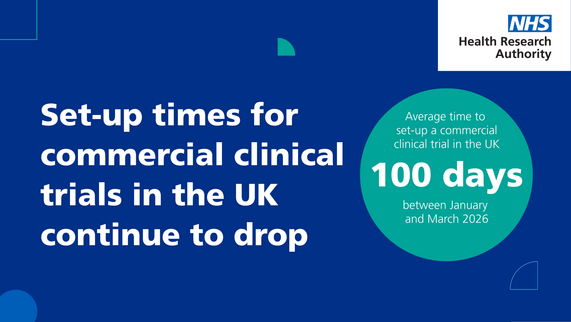
On Wednesday, the government published new data showing that the average time to set-up a commercial clinical trial in the UK was down to just 100 days between January and March 2026.
The Life Sciences Sector Plan, published in 2025, set a target for 95% of UK clinical trials to be set-up within 150 days by March 2026.
100% of the 24 commercially sponsored clinical trials set-up between January 2026 and March 2026 were set-up within the 150 days target.
A key part of this success has been our work alongside the Medicines and Healthcare products Regulatory Agency (MHRA) on the Combined Review process.
Supporting trusted research
We've been closely involved in one of the most significant developments in the use of health data for research in England, with the creation of the NHS Research Secure Data Environment (SDE) Network.
Now, with all regional SDEs in place across England and continuing to mature, Dr Paul Mills, HRA Confidentiality Advice Service Manager, has written a blog about how the NHS reached this important milestone and why it's a significant achievement for researchers, NHS organisations and patients alike.
Why I joined the CAG
The Confidentiality Advisory Group (CAG) is an independent body that reviews applications for research purposes and provides expert advice on the use of identifiable patient information.
Through the expertise of its members, CAG helps ensure research can proceed in the public interest while maintaining trust and protecting patient confidentiality.
We spoke to Kim Keltie, who joined CAG in February, to find out more about her experiences as a CAG member so far and what she has learnt from the role.
Information Commission consultation
We've responded to an Information Commission public consultation on draft guidance about the use of anonymisation and pseudonymisation for research purposes.
The guidance is intended to help organisations understand when information is personal data, how identifiability should be assessed and how these principles apply in research settings.
Dr Alison Knight, Data and Privacy Specialist and Research Data Policy Lead, has written a blog about why the questions raised in the consultation are particularly important in health and social care research.
Government accepts AI regulation recommendations
The government has responded to the National Commission into the Regulation of AI in Healthcare, accepting all 44 recommendations and setting out a UK-wide approach to implementation.
We welcomed the government's response, and the phase 3 launch of the Medicines and Healthcare products Regulatory Agency (MHRA) AI Airlock, which were both announced on the same day.
We will continue working with the MHRA and other partners to help ensure that regulatory and research governance arrangements remain clear, proportionate and connected as AI technologies develop and move into wider use.

World first Strep B vaccine trial recruiting participants
A world first trial has begun recruiting participants following approval earlier this year.
The BEATRIX trial, which was recently in the news, will evaluate the safety and effectiveness of a vaccine given to pregnant women to protect infants from Group B streptococcus (GBS), a common cause of life-threatening infection in babies.
An application for the trial was reviewed and approved by the East of Scotland Research Ethics Committee (REC) in 2025.
Welcoming the MHRA's new strategy
Earlier this month, we welcomed the launch of the Medicines and Healthcare products Regulatory Agency's (MHRA) new strategy.
Their new strategy outlines the MHRA's key priorities up until 2030 and closely aligns with our own key strategic objectives, in particular around transparency, public involvement and high performing approvals processes and a commitment to collaborative working.

Improving our digital services
We're continuing to make steady progress towards a simpler, more joined-up way of supporting health and care research across the UK through our work to develop our new digital service, Plan and manage health and care research.
The service will allow users to plan and prepare new research, make changes to existing research and review and approve applications in a seamless way.
To keep up-to-date with our progress and our plans to gradually open up the service to more users, please sign up for the .

Below are some updates you may have missed about health and social care research in the UK:
- the MHRA is launching a consultation on proposals that would allow schools to purchase and keep spare adrenaline nasal sprays for emergency use in children with severe allergies
- the government has confirmed it will continue to accept CE marked medical devices on a long-term basis, following a public consultation held earlier this year
- people living with brain cancer will get a faster route from research to treatment - the announcement follows the Prime Minister and Health Secretary’s meeting in Downing Street with Archie Goodburn, a 25-year-old swimmer with inoperable brain cancer
|