Aberdeenshire primary pupils receive visit from care home resident who attended school 90 years ago
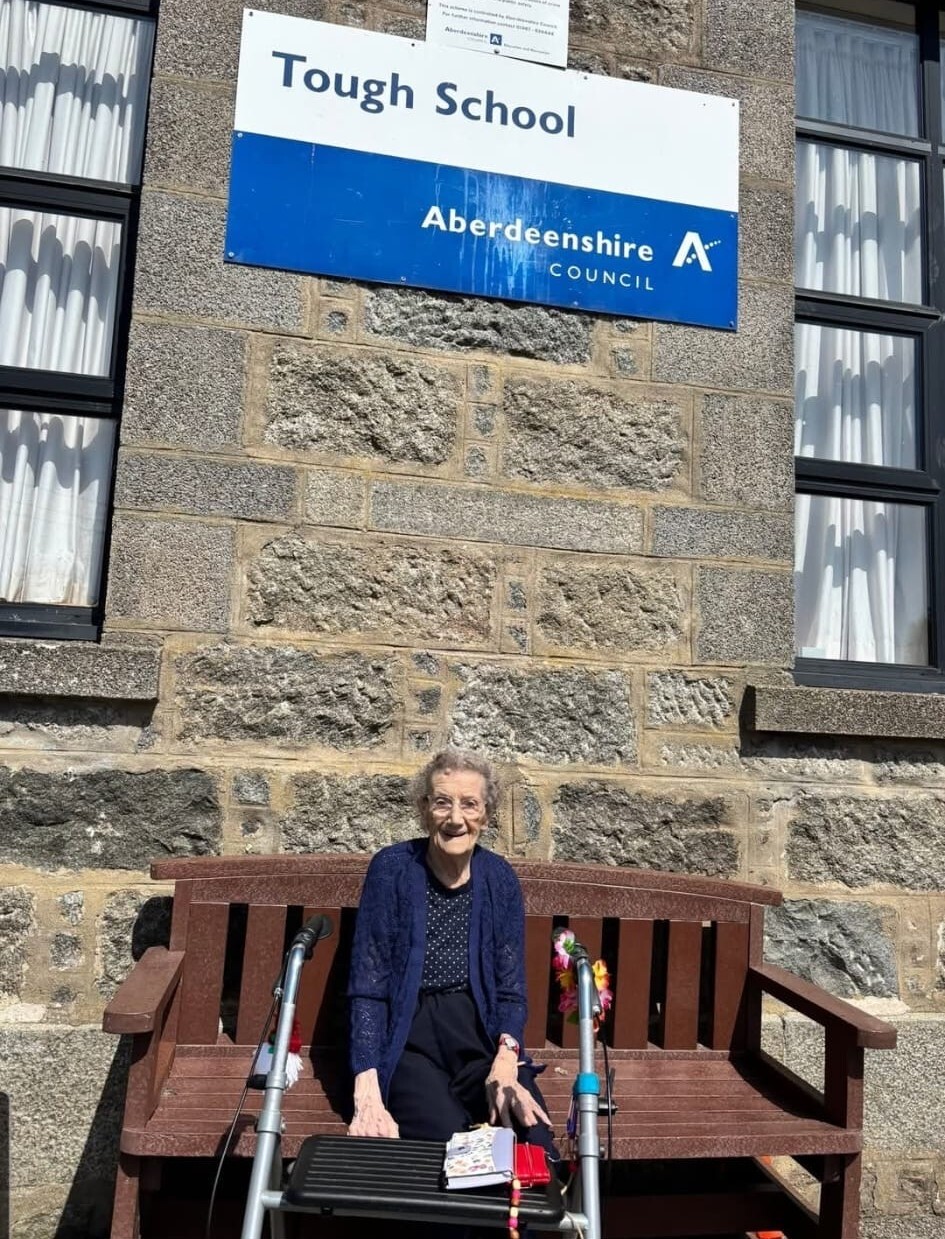
A resident from Pitcairn Lodge care home in Aberdeenshire, returned to the primary school she attended 90 years ago.
Margaret Milton, age 96, visited Tough Primary School where she attended in 1935. Margaret often talked fondly of her primary school days, so Gillian Wilkie, lifestyle and wellbeing co-ordinator, arranged a visit with the school. Margaret went with Gillian and her daughter, also Margaret, to reminisce about her younger years.
Margaret still remembers her teacher's names and even has her original slate for writing that she got in primary 1, which she took with her to show the children.
She did a Q&A with the children about what school was like in the 1930s. The children were shocked to learn that the toilet was outside in the playground!
Margaret said: “It was a good day out and I enjoyed seeing the school again. I liked speaking to all the kids and answering their questions.”
Gillian said: “Organising this visit was incredibly rewarding. Seeing the happiness on her face as she returned to her childhood school and shared memories from so many years ago was truly special.”
Ruth Witkowski, home manager, said: “At Pitcairn Lodge, we are passionate about helping residents maintain connections to the people, places and communities that have been important throughout their lives. Margaret's visit to her childhood school was a wonderful example of how community involvement can enrich wellbeing, spark treasured memories, and bring people of different generations together. It was a privilege to hear about such a warm welcome from the Tough School community for this very special moment."
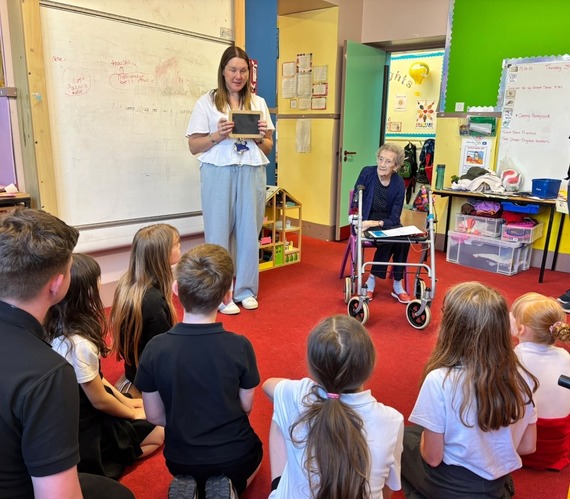
Margaret and Gillian talking to the pupils at Tough Primary School.
Uist care home staff improve medication management with help from Care Inspectorate
Care home staff in Uist have, with the support of the Care Inspectorate, improved overall medication safety for their residents by overhauling their medication management systems.
Marina MacLeod, senior social care worker, and Marion Henderson, peripatetic manager older persons’ services, who both work in care homes in Uist, contacted our senior improvement adviser, David Marshall, for support with medication management within their services.
The services were experiencing a number of challenges, including poor medication administration practices, inadequate ordering and review processes, medication counts that did not tally, and a lack of explanations when discrepancies occurred. The team recognised that medication management processes needed to be strengthened to improve outcomes for residents and create a smoother, more reliable system for staff.
The team began the project by dividing the home into two sections. One side continued using the existing Medication Administration Record (MAR) chart system, while the other trialled a redesigned set of MAR charts that were cleaner, clearer, colour-coded and more organised. This approach allowed the team to compare the effectiveness of the new system against existing practice.
To ensure any changes would work in practice, volunteers from the social care workforce were actively involved in the project. By engaging staff from the outset, the team was able to gather valuable feedback and develop solutions that reflected the needs of those using the charts every day. As a result, staff were more willing to embrace the changes and contribute to their success.
The impact was seen almost immediately. Missed signatures on MAR charts reduced significantly, although occasional issues remained with medications running out of stock. To address this, the team introduced a communication sheet at the front of each MAR folder. Staff could use this to flag medications that were running low, and a member of the management team would sign the sheet once the issue had been actioned. This simple process improved communication and helped prevent stock shortages.
The project also explored ways to improve the recording of topical medication administration. Initially, individual folders were placed in residents' rooms so staff could sign for applications at the point of administration. However, missed signatures continued to occur. Following feedback from staff, the folders were moved to a central location where they were easier to access. Almost immediately, compliance improved and missed signatures became very rare.
Staff engagement was a key factor in the project's success. Team members quickly got behind the changes, providing feedback and practical suggestions throughout the process. They responded positively to the redesigned MAR charts, and their insight played an important role in shaping improvements, particularly in finding an effective solution for recording topical medication administration.
The results of the hard work of Marina and Marion, and staff, are shown in charts below. You can see the improvement (circled in red). Although this was one service, the work was split into two units as they functioned separately, and changes tested separately as shown.
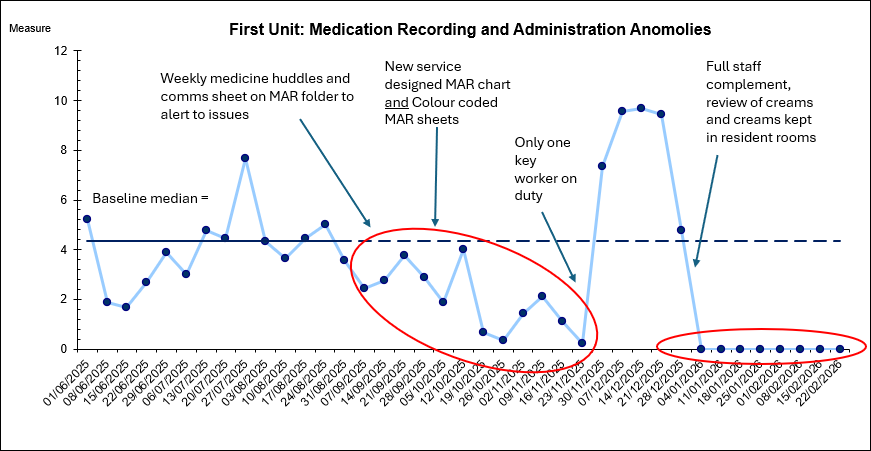
First unit MAR
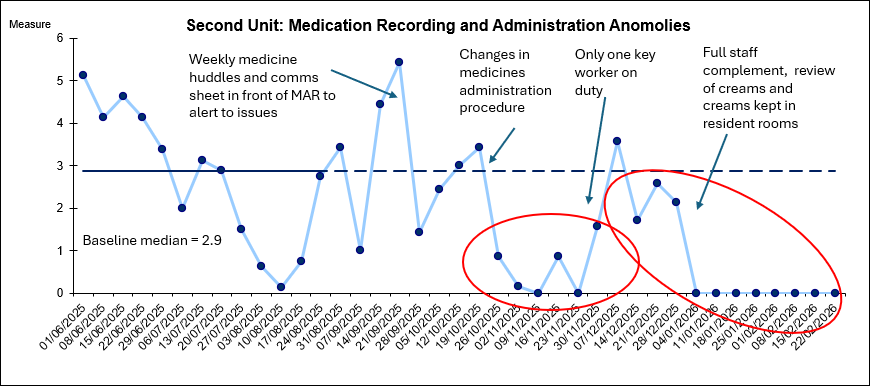
Second unit MAR
David said: “While no-one is saying this is everything solved forever - it’s a complex system - I think the system and approach taken by Marina and Marion gives a great platform going forward, and the good work deserves to be recognised”.
Karen, inspector of the service, said: “Marina and Marion are excellent examples of managers who have been proactive in seeking advice and guidance from the Care Inspectorate, to support positive outcomes for the health and wellbeing of people they care for. I also know that they have appreciated all of the support and guidance David provided. I personally really liked the colour-coded MAR sheets they produced. I understand that it is a time-consuming process but it just makes it so much easier for staff when administering medication. I have also been suggesting to other services about the comms sheet, simple idea but effective."
Marion said: “Speak with your inspector or find someone from within the Care Inspectorate to assist/advise you when there are issues. I think it makes for better working relationships and I have had good advice/ideas from all our contacts at the Care Inspectorate. Inspectors are looking at ways that we can improve our services, so if we can identify issues early and get the right advice we can begin to sort them out and give better outcomes for our residents and staff groups – which is what we are here for really.”
Updated guidance on how we inspect regulated care services
We have published updated guidance, How we inspect regulated services: guidance for providers of regulated care settings and the public.
The document explains our approach to inspecting regulated care services in Scotland, including how we plan inspections, gather and consider evidence, make evaluations, and share feedback with services.
It is intended to support providers, people experiencing care, families, carers, and the wider public to understand what to expect from inspection and how inspection supports improvement in the quality of care.
We also have an easy-read document, How we find out about your care and support for people using services.
Keeping children safe
We launched the SIMOA (Safety, Inspect, Monitor, Observe, Act) campaign in August 2021 to help support the ELC sector and reduce the number of incidents of children leaving settings unaccompanied by an adult. We also produced a series of practice notes to support improvement and to help ELC staff keep children safe.
We ask all ELC services to please raise awareness of the SIMOA campaign across your setting or networks as this campaign helps you consider the child’s relationships and safety. We also strongly encourage you to consider the physical environment in your setting and the supervision of children by your staff.
You can review the SIMOA campaign tools and practice notes on our website. They will help to remind all ELC staff to be aware of how and why children could leave a setting without a responsible adult and actions to prevent these incidents from happening.

Reducing Stress and Distress Programme evaluation report
Healthcare Improvement Scotland has published the latest Reducing Stress and Distress Programme evaluation report. This report summarises the impact and learning from the Reducing Stress and Distress Improvement Programme for the period January 2025 - March 2026, delivered by Healthcare Improvement Scotland, Care Inspectorate, and NHS Education for Scotland.
This poster explains more about the Reducing Stress and Distress Improvement Programme.
They have also produced a case study: taking a holistic approach to improve understanding and support for patients experiencing stress and distress: July 2026.
Become an inspection volunteer
Our work is improved by involving people who use services and their carers. We have many innovative ways that people can get involved with us and can influence our work.
If you have personal experience of using a care service or you have cared for someone close who has used a care service there are many ways you can get involved with us. You do not have to have any qualifications. Your personal experience gives you a unique insight.
You can apply to become an inspection volunteer by completing our application form.
If you would like to find out more about becoming an inspection volunteer, need help to complete the application form or would like us to post you an application form, please email us at This email address is being protected from spambots. You need JavaScript enabled to view it..
Listen to what some of our inspection volunteers said here.
Recent publications
Webinars and events
Stay up to date with all our webinars and events on our website. You can watch recordings of our webinars on YouTube.
Enjoy this newsletter? Sign up for others!
As well as our Care News e-newsletter, we also send out vacancies updates, improvement updates and others! You can select these as a topic of interest and change your preferences anytime here.
Find out more about our work at www.careinspectorate.scot
Contact us
|